No products in the cart.

If you are looking for information on how to deny consent to AI at Meta and exercise your right to object, this is it.
BEFORE WE BEGIN… Traffic has spiked hugely since publishing this article, causing server overload and, therefore, a slower website. So, my apologies if this has affected you.
To compensate for the disruption, I’m offering you a 10% discount on everything directly available in-store right now. Simply use the code SPIKE10 at checkout (only once per user). This was meant to be a one-off, but I’ve decided to keep this on for everyone who lands on this page.
Also, some of you are finding this article very helpful and sending small donations via ko-fi… OMG, you are awesome!
So, many thanks for landing here and welcome! I hope this article helps you.
This article is updated with important post-deadline information.
So, Meta Sent an Email…
This morning, I received an email from Meta (the company that owns Facebook, Instagram, WhatsApp, and several other services). It looked like a regular notification that privacy policies were updated, which is normal practice. When new features are released, the need to update policies and include these new additions often arises. Hence the notifications in your inbox.
I normally don’t pay too much attention to these, which is not good practice. But since I have an interest in AI (as you may have noticed on this blog), I had a quick glance at the email.
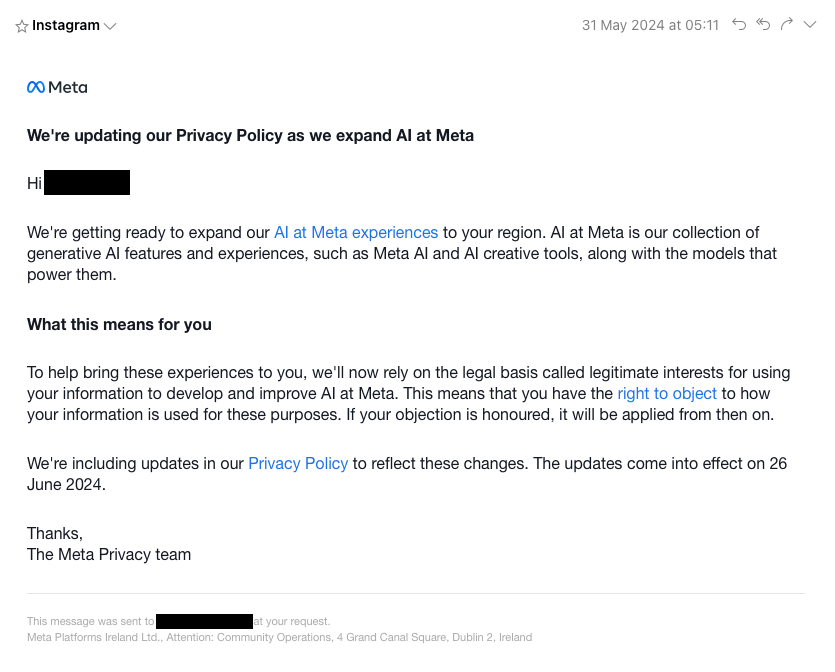
It looks like it’s going to be the usual policy update, probably written in convoluted legalese so that we common people cannot figure out its meaning. But then again, I do have an interest in AI so clicked on the “right to object” link, to see if there was anything interesting. I even thought there might be something I could learn, considering that I use trained models myself and offer my own images for training.
Thank you very much, curiosity! This was definitely something I needed to see, and you probably need too.
So, here’s why I decided to deny my consent to AI at Meta.
Object to your information being used for AI at Meta
The link goes straight to the Instagram Help Centre. Right now, the page is only available in certain regions, but I have no way to tell which ones. You also need to be logged into your Instagram account, but it does not appear as a link in the Help Centre sidebar menu. So, I cannot provide a direct link. It seems you may have to wait for the same email to find its way to your inbox.
But if you are reading this blog, it may already have.
Update: I was able to find the link for everyone to exercise their right to object. Only after Meta sent me their confirmation email did I find a link to review the GenAI information and privacy. So, here is a direct link to the AI page. At the bottom, you can click on “right to object.” You will have to do this for every account you have.
Anyway, here’s a screenshot:

My View
As a digital artist, I loosely side with allowing AI to use my Art and Photography to train. So, I would not mind letting Meta’s AI use my Instagram photos. They are already publicly available, but the resolution on Instagram is terrible. The images are barely usable for commercial purposes if anyone were to steal them (but know that I monitor them with Pixsy).
I require other users to credit me within the first lines of their caption if they decide to reshare an image. But I’m OK, in principle, with Meta training an AI with my images.
The thing is, even if I’m viewing this text on the Instagram Help Centre, this is not just Instagram. It’s Meta. So they could potentially use everything I have ever posted on the other platforms as well: Facebook, WhatsApp… everything.
Am I OK with that? Hmmm, I need to think about it for a minute. Are you OK with that?
Why Deny Consent to AI at Meta
My main problem is that my Facebook and WhatsApp activities are more personal than my Instagram ones. On Facebook, for example, I only connect with people I know, most of whom I have met in person. It really is my ‘friends and family’ bubble, plus a few. For everyone else to connect with me, there is my Facebook Page (I actually have a few for each of my activities).
I am also not too reassured with “we do not use the content of your private messages“.
We already know that WhatsApp can collect all this information. It says as much in its privacy policy, that it collects “information about your activity (including how you use our Services), how you interact with others using our Services (including when you search for and interact with a business), and the time, frequency, and duration of your activities”. And also that “even if you do not choose to use our precise location-related features, we use IP addresses and other information like phone number area codes, to estimate your general location”.
It doesn’t seem to care about my privacy, does it?
WhatsApp has other privacy issues, too, but they’re beyond the purposes of this post.
If you look well, it already has its own loophole in plain sight: “We may still process information about you […], even if you object, [… if you] are mentioned in posts or captions that someone else shares”.
So you tell me that you won’t use my private messages with friends and family, but at the same time, you will use them, if friends and family have not objected too. That’s shady (as expected, I guess).
That’s why I believe everyone should deny consent to AI at Meta, not just me, you, and your hush puppy. Everyone.
How to Object
It didn’t take me long to decide this was necessary. So, I filled out the form and exercised my right to object.
Here is the exact text I used to fill out the form and deny consent to AI at Meta. I received confirmation within 5 minutes: “We’ve reviewed your request and will honor your objection. This means your request will be applied going forward“. So this works, which is why I confidently share it with you.
I appreciate the explanation of Meta's AI development process. To ensure my privacy, I kindly request that you exclude all my data, including posts, photos, and message content, from any future AI training.

I am concerned about the potential for my data to be used in ways I cannot control or anticipate.  By opting out of AI training, I want to ensure my data is used only for the core functionalities of Meta's products, not for unidentified future applications.

The use of my data for AI training raises concerns about transparency.  I would prefer my data not to be used in ways that could personalize my experience on Meta platforms in unknown or unwanted ways.
Just enter this text in the required field under “Please tell us how this processing impacts you“. You can leave the optional field empty, as I did, or add any further comment you may have. But this was enough for me.
I am now going to share this with everyone I know so they don’t fall into the loophole. I hope we can all keep each other safe. Ideally, something similar will be available to opt out of the controversial Adobe update, too.
You could also give Meta its own medicine by asking an AI to craft the answer for you. While I cannot guarantee it works as well as the solution above, it can certainly leave a pleasant feeling.
The way I would do it is to ask an AI, like ChatGPT, Gemini, Claude or else something along the lines of “You are a privacy-expert solicitor, please write down 2-3 effective sentences to respond to the following policy at Meta and object to the use of my personal data for the purposes of AI training. This is the policy: [copy text from the Instagram Help Centre]”.
Has Your Data Already Been Used?
As mentioned in the comments section below, I can now add a separate link here to help you if AI at Meta has already used your data.
If you find that your content already appears in generative AI creations by Meta, via apps like Meta AI or AI Creative Tools, you can use the link below to:
- Access, download or correct any personal information from third parties used for building and improving AI at Meta;
- Delete any personal information from third parties used for building and improving AI at Meta;
- Object to or restrict the processing of my personal information from third parties used for building and improving AI at Meta.
Here is the link: https://www.facebook.com/help/contact/510058597920541 (thank you, Max).
Actions are also taken on a more global scale. As Paolo Attivissimo reported on his blog (in Italian), a Vienna-based privacy campaign group filed complaints in 11 European countries against Meta on Thursday. The group says the global tech giant’s planned privacy policy change would allow unlawful use of personal data. This is, in fact, “clearly the opposite of GDPR compliance” because users should opt-in to consent rather than opt-out to deny it.
However, the court rejected this and referred to a corresponding assessment by the Irish data protection authority responsible for Meta. There was no violation of EU law.
More Extreme Measures?
Upset Instagram users are currently talking about abandoning the platform, which seems to be a recurring theme. Many are posting their sentiment and seem to be leaving.
But I have never resorted to that, even during my irritating shadowban, and I won’t recommend that now, either. This is simply to inform you about your right to object and how to exercise it.
But if you are looking for alternatives, Cara has, very conveniently, launched its platform in the past few days. You can find @fabienb on Cara as well, of course.
Maybe it’s another fad (or worse, a scam, only to collect and sell your data, like Vero) or maybe not. We’ll see.
I hope this helps you.
You Missed the Deadline, What Can You Do Now?
Meta set a deadline for May 27, 2025. This date was not explicit when I first wrote this post, but it was made public (kind of) at a later stage. From that date, Meta will lawfully use public data from adult users on Facebook and Instagram to train its artificial intelligence.
This remains controversial to this day, because very little is known about the exact use of the data. It is also not clear whether and how Meta intends to protect personal data or is even able to do so once it has been incorporated into the AI. In addition, the Llama language model, for example, is an open source model, i.e. freely accessible. This means that Meta can hardly recall or update a model once it is published, incorporating your data. Data protection activist Marcel Schrems, therefore, sees another violation of the right to be forgotten guaranteed under EU law.
If you missed the deadline to object to Meta using your data for AI training, following the steps indicated above, you can still submit an objection. However, this will only apply to future content and not to data already used.
Meta does not make it easy for its users but there is an objection form that can be accessed for Facebook and Instagram.
The form can also be found in the apps, but is well hidden:
- In the Instagram app, it can be found in the “Privacy Center” sub-item of the profile settings.
- In the Facebook app, there is a “Privacy Policy” item in the settings menu.
If the same email address is used for both platforms, it is sufficient to fill out the form for one of them.
A Note on WhatsApp
Note that WhatsApp is not mentioned. According to Meta’s definition, the messages sent on WhatsApp do not fall under “public information” and are therefore not used for training the AI. However, anyone who interacts with Meta AI via WhatsApp must first agree to the terms of use, thereby granting permission for the content entered to be used by Meta. It sounds like well-paid Meta lawyers have found yet another loophole, but it is what it is.
It Never Ends: The Meta AI App
If you thought Meta’s data collection practices were problematic before, their standalone AI app has managed to reach new depths of privacy catastrophe.
Launched in April 2025, the Meta AI app features a “Discover” feed – essentially a public stream where users unknowingly share their most intimate conversations with the chatbot. We’re talking about people sharing details about tax evasion, medical conditions, family legal troubles, and yes, even questions about why some flatulence smells worse than others.
Many users appear to think they’re having private conversations, only to discover their personal queries are being served up for public consumption alongside their real Instagram and Facebook profiles.
The app’s design is nothing short of a masterclass in dark patterns (manipulative interface tricks that lead users to do things they never intended).
When you chat with Meta AI, there’s an innocuous “share” button that, when pressed, publishes your conversation to the world. However, here’s the kicker: if you’re logged in through Instagram and your account is set to public, your AI searches automatically inherit that visibility. Meta provides virtually no indication of privacy settings, no familiar sharing cues, and certainly no clear warning that you’re about to broadcast your personal struggles to strangers.
What makes this particularly troubling is how it targets society’s most vulnerable users. The feed appears to be dominated by older adults who seem genuinely confused about the public nature of their posts. Some even include phrases like “please keep this private” in what are already public conversations.

Next
Meta has recently added a warning label after mounting criticism, but damage limitation feels rather hollow when you’ve already created a system designed to monetise human vulnerability.
This isn’t just another privacy mishap; it’s a glimpse into a Truman-Show-like future where our most personal moments with AI become content for others to consume, all wrapped up in the familiar Meta playbook of exploitation masquerading as innovation.
In the meantime, Mozilla has launched a petition demanding Meta shut down this invasive feature, arguing that users “have the right to know when they’re speaking in public, especially when they believe they’re speaking in private”.
And do not download the Meta AI app; alternative options are available.




10 comments
Thank you so much!
As a german, i did not find the same after going on the link you posted. It lead me to the facebook Help center with following options:
What best describes your request?
– I want to access, download or correct any personal information from third parties used for building and improving AI at Meta
– I want to delete any personal information from third parties used for building and improving AI at Meta
– I want to object to or restrict the processing of my personal information from third parties used for building and improving AI at Meta
and that I have to state:
1. Relevant Prompts: Type any prompts you entered that generated a response that included your personal information
2. Screenshot of response: Attach one screenshot that shows your personal information in a response from an AI at Meta model, feature or experience. Screenshot must be less than 4 MB and saved as a JPG, PNG, GIF, TIFF, HEIF or WebP file.
Shit’s rigged!!
I believe this is something that Meta is rolling out in different countries at a different time, and being in the EU I assume there is a lot of red tape to go through first (thankfully. in this case). This is maybe why you don’t see the same options right now in Germany, but I’m sure this will be helpful again soon. Thanks for stopping by!
If you do find any of your content on from their generative ai, you can use this well hidden form to request deletion of your info.
https://www.facebook.com/help/contact/1266025207620918
That’s great, thanks a lot Max. I will update the post to include your link.
Thank you for this. Your process worked 100%.
I’m glad to hear it worked for you too, thanks! :)
I tried to object with all your listed steps. But it doesn’t work. When I send that text another window appears to verify my e-mail adress that is connected to my account. It stated a code has been sent to my mail and i should enter that one to confirm. But this e-mail never arrives on my adress at all. It doesn’t appear in the spam folder either. Tried it multiple times, day by day with several browsers (Firefox, Safari, Chrome etc.) but no luck. :-/
Hey Klaus. Sorry it doesn’t work for you. I have tried to access all the links again, and they all still show the same pages and steps to object. All I can think of is that it may be different in EU countries now because of GDPR, and the ongoing opposition that Meta is facing in the 27 countries.
You can also try with the link that Max has posted in another comment, that should be more generic. Hope it helps
In the United States of America the process is a little bit different but this info was able to walk me through. thx
Thanks Isa, I’m glad it worked for you. Based on the comments, it seems Meta has tailored the page differently for every country, and may have also adjusted a few things since posting (following lawsuits, etc). But once you get to a form to fill, the text should still be effective because it’s worded in a way that doesn’t leave them options.
Cheers.
Comments are closed.